Showing posts with label origin. Show all posts

Friday, February 4, 2022

Cheddar cheesemaking in history

Cheesemaking originated as a crude form of food preservation. Cheddar cheese is a hard, ripened cheese with a long shelf life and without any surface Flora. Cheddar cheese was firstly manufactured in the town of Cheddar; England.

Cheddar has its origin in Somerset in England where it has been produced since the 12th century. By the middle of the 19th century, it was the second most produced cheese in Britain after Cheshire. Output had expanded from its Somerset origins into Wiltshire, Gloucester and even further afield into Scotland.

The cheese has most likely got its name from the town of Cheddar where originally caves were used to store the cheese during ripening. The caves provided a very good environment for the maturation of the cheese due to the caves humidity and its constant temperature.

Cheddar cheese became popular among English nobles and made appearances at many royal banquets. In 1107, King of England, Henry II (reigning in England from 1154 to 1179) purchased more than 10,000 pounds of the cheese. He declared Cheddar cheese to be the best in Britain.

In the reign of Charles 1 (1625 to 1649) parliamentary records show that the cheese made in Cheddar was sold before it was even made and indeed was only available at the court.
The milk used in the manufacture of the cheese comes from cows grazed within the defined area of Somerset, Dorset, Devon and Cornwall. Cheddar cheese were traditionally produced as large cylindrical shaped loafs with a weight of around 30 kg but nowadays in the modern industrial process the cheese is instead formed into rectangular blocks to facilitate the handling of the cheese.

Significant improvements in the cheese manufacture have been made over a century. For instances, pasteurization process was applied to the cheese milk in the beginning of the 1900's.

Mechanization for the Cheddar cheese manufacture was introduced around the 1950's. The mechanized system could essentially shorten the whole cheese manufacture, which would be beneficial for the cheese manufacturers.

The earliest records of cheese production in the United States, showed that more than 45 million kilograms of cheese was produced in the United States in 1849.

The first cheese factory in the United States was built in New York in 1851, and it produced Cheddar.
Cheddar cheesemaking in history 

Monday, September 24, 2018

The origin of blue cheese and its history

Blue cheese is characterized by visible blue-green veins of mold throughout the interior and by a sharp, piquant flavor. Blue cheeses have probably been produced for a long time either deliberately or by accident before they were describe in writing.

Legend has it that the first mouldy cheese was discovered thousands of years ago when an absent-minded shepherd left his curds and bread in a cave while he was off chasing sheep.

The shepherd returned to find a moldy sandwich but was so hungry he ate it anyway. Since then, moldy cheeses such Roquefort, Gorgonzola, English Stilton and Danish blue have been developed by Europeans into gourmet fare.

Gorgonzola was the first Bleu-veined cheese to be mentioned in the literature, in 879, while Roquefort was describe in customs papers in 1070. Gorgonzola originated when an innkeeper in the Valsassina area, stored stracchino cheese in his cellar for a bit too long, and some developed a blue mould. He served regardless to the local cheesemakers who loved it and copied his method.

Stilton was not mentioned until the 17th century. It was Britain’s most famous blue cheese, named after the town of Stilton, where a busy stagecoach station on the Great North Road the enterprising landlord of the Bell Inn sold the cheese to appreciate travelers.

In Denmark, the production of Danablu and Mycella, Blue Cheeses from cow’s milk started in the 1870s. Denmark is known for its Danish blues or Danablu. This cheese was invented by Marius Boel, who wanted to create a blue cheese that as similar to Roquefort.

Although Boel started with this French cheese as model, the resulting Danish blue, is entirely different. Another Danish blue cheese is Bla Castello, which was developed in the 1960s.

In 1937 Experimentation Station of Iowa State University developed a process for making blue cheese from homogenized milk, which became the standard for the blue cheese industry and was used by the Fred and Robert Maytag to produce their Maytag Blue Cheese.

The earliest makers of blue cheese used bread to begin production of the distinctive mold and then waited patiently for the veins of mold to grow and spreads naturally between the curd.
The origin of blue cheese and its history

Wednesday, December 14, 2016

Feta cheese

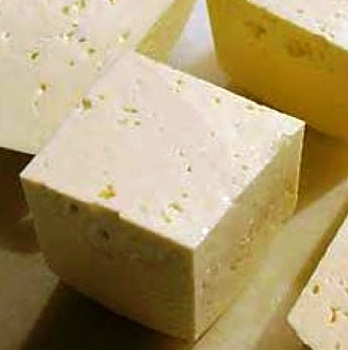
This type of cheese is very popular to make from goat’s milk. Feta cheese is aged in a brine solution after the cubes have been salted in a brine solution for at least 24 hours.

Soft goat cheeses such as feta cheeses - a salty, white cheese originating in Greece which can be made with goat or sheep; milk – contain more moisture and are comparable to cheese made from part-skim cow’s milk.

Feta texture is creamy or crumbly dry, varying according to age, local environment, animal breeds and starter cultures. Feta is a protected designation of origin cheese and may be the most famous Greek cheese occupying more or less 70% of the Greek cheese armlet.

One and one-half ounces of feta cheese has 9 grams of fat, about the same amount as in an equal amount of mozzarella or Neufchatel cheese.
Feta cheese

The most popular posts